By Gobinath Ponnuthurai
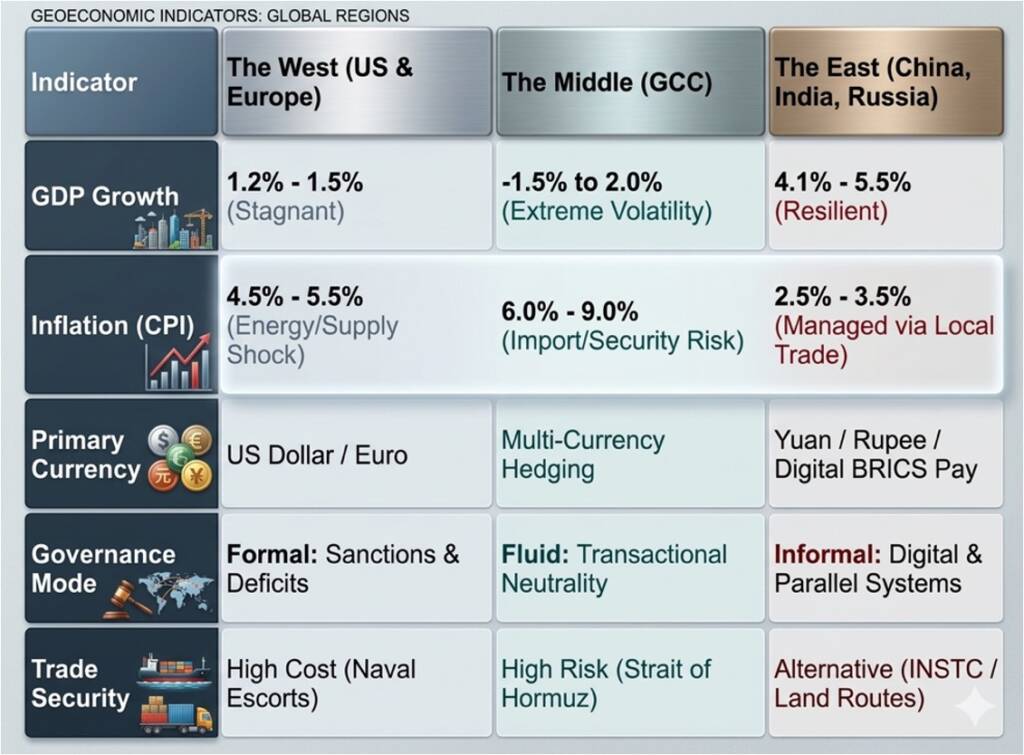
As of March 2026, the intensification of the US-Israel-Iran conflict has moved beyond a regional security crisis, evolving into a protracted systemic shock—a “Long Quagmire.” This article argues that we are witnessing the terminal phase of unipolar economic governance. The conflict has created a profound governance vacuum where the West’s ability to provide global public goods—stability, predictable maritime security, and a neutral reserve currency—has been fundamentally compromised by the escalating costs of war.
Applying Hegemonic Stability Theory, our analysis reveals a world fracturing into three distinct governance spheres:
· The West (The Exhausted Hegemon): Under the weight of “Securo-nomics,” the US and Europe have transitioned from a rules-based order to a risk-based order. The weaponization of the US dollar through “War Sanctions” has sparked a permanent erosion of trust in Western formal institutions, forcing a pivot toward domestic defence subsidies and “de-globalization by necessity.”
· The Middle (The Transactional Pivot): No longer tethered exclusively to the “Security-for-Oil” pact, the GCC has adopted a model of Transactional Neutrality. By rerouting Sovereign Wealth Funds toward the Global South and experimenting with non-dollar energy settlements, the Middle is actively decoupling its economic survival from Western military outcomes.
· The East (The Architect of the Parallel Order): Led by China and India, the East is leveraging the West’s distraction to operationalize a parallel governance architecture. Through the stress-testing of informal systems like BRICS Pay and the mBridge digital payment rail, the East is capturing “Governance Market Share,” offering a stable, non-interference-based alternative to the volatility of the West.
The “Long Quagmire” is not merely an interruption of global trade; it is the catalyst for the rise of Economic Archipelagos. This study concludes that the traditional concept of a singular, unified “Global Governance” system is becoming obsolete, replaced by a bifurcated reality where technology and strategic autonomy dictate the new rules of the global game.
II. The West: From “Rules-Based” to “Risk-Based” Governance
For eight decades, Western economic governance was predicated on the “Peace Dividend” and the expansion of the Liberal International Order. However, as the US-Israel-Iran conflict enters its second month with no resolution in sight—a “Long Quagmire”—the West is undergoing a fundamental transformation. Governance is no longer about the expansion of open markets; it is about the management of existential risk. This section explores the erosion of the US Dollar’s neutrality, the fiscal exhaustion of the “Exhausted Hegemon,” and the de-industrialization of the Eurozone.
The Erosion of “Neutral” Hegemony: The Dollar as a War-Standard
The most profound shift in global governance is the changing nature of the US Dollar (USD). Historically, the USD’s dominance was rooted in its perceived neutrality and the deep liquidity of US Treasuries. However, the 2026 quagmire has solidified a trend of “War Sanctions”s that have permanently altered this perception.
Since the onset of hostilities on February 28, 2026, the US Treasury has deployed the most aggressive secondary sanctions regime in history, targeting not just Iranian entities but any third-party financial institution facilitating Tehran’s “Shadow Trade.” While effective in the short term, this has created a “Sanction Risk Premium” for global reserve managers. As noted by recent IMF data, while the dollar still accounts for approximately 57% of global reserves, the “unadjusted” value of these holdings has become increasingly volatile.
Under the theoretical lens of Hegemonic Stability Theory (HST), a hegemon must provide the “public good” of a stable currency. When the currency becomes a primary instrument of warfare, it ceases to be a public good and becomes a private tool of statecraft. For the West, this means the dollar is transitioning from a “Global Standard” to a “Western Bloc Standard.” The governance of the dollar is no longer about global price stability; it is about political compliance.
Fiscal Exhaustion: The “Securo-nomics” Trap
The United States enters this conflict with a debt-to-GDP ratio exceeding 122% (as of late 2025). Unlike the “surgical” interventions of the early 21st century, the 2026 quagmire requires a sustained, front-loaded military outlay. Estimates suggest that US defence spending will surge past $1.1 trillion (3.3% to 3.5% of GDP) to sustain multi-carrier deployments and replenish Israeli interceptor stocks.
This is the birth of “Securo-nomics.” In this governance model, fiscal policy is dictated by the needs of the “Department of War” rather than social or infrastructure investment. The economic cost of this quagmire is not just the price of missiles, but the opportunity cost of lost domestic growth.
· Crowding Out: As interest rates remain “Higher for Longer” (holding at 3.5%–3.75% through 2026) to combat war-induced energy inflation, private investment is being crowded out by the necessity of financing the national debt.
· Reprioritization: The US National Security Strategy of 2026 explicitly notes that the Middle East is now a “secondary” theater compared to China. Yet, the quagmire forces a “doubling down” on a secondary theatre, leading to what historians call “Hegemonic Overstretch.”
Governance in the West is now defined by “De-globalization by necessity.” Instead of investing in global trade corridors, the US is forced to redirect capital into domestic “Defense Industrial Base” subsidies. The governance of the economy has shifted from the “Invisible Hand” of the market to the “Heavy Hand” of the national security state.
The Eurozone’s Dilemma: The End of Normative Power
If the US is the “Exhausted Hegemon,” Europe is the “Collateral Victim.” The Eurozone’s economic governance has long relied on its “Normative Power”—its ability to set global standards for the Green Deal, human rights, and fair trade. The 2026 quagmire has effectively shattered this.
With the Strait of Hormuz paralyzed, European gas prices spiked 20% in early March 2026, and Brent crude has peaked at $119/bbl. Europe, which imports 90% of its gas and nearly all of its oil, is facing a “War-Standard” energy crisis.
1. Permanent Manufacturing Slump: Energy-intensive sectors (chemicals, steel, automotive) in Germany and Italy are facing a permanent loss of competitiveness. Governance is shifting from “Green Transformation” to “Survival Subsidies.”
2. Strategic Exposure: The EU’s reliance on US LNG to replace Russian gas has proven to be a double-edged sword. As US domestic demand and war-related exports tighten the market, Europe finds itself at the mercy of a “War-Standard” price point.
3. The Erosion of Autonomy: The EU’s “Clean Industrial Deal” is being sidelined as Member States are forced to put their economies on a “Warfare Footing.” The governance focus has shifted from environmental sustainability to “Energy Sovereignty” at any cost, including the return to coal and the suspension of environmental safeguards.
The Fragmented West
The result is a West that is more unified in its security stance but more fragmented in its economic influence. By prioritizing “Security Capital” over “Productive Resources, the West is inadvertently ceding the “Economic Governance” high ground. The institutions that once defined the world—the IMF, the WTO, and the World Bank—are increasingly viewed as extensions of Western security policy rather than neutral arbiters of global prosperity.
As the West becomes an “Economic Fortress,” it leaves a vacuum in the “Middle” and “East” that is already being filled by alternative architectures.
III. The Middle: The Rise of Transactional Neutrality
For decades, the Gulf Cooperation Council (GCC) states operated under a clear, albeit rigid, governance framework: the “Security-for-Oil” pact. In this arrangement, the West (primarily the United States) provided an umbrella of maritime and territorial protection, while the Middle ensured the steady, dollar-denominated flow of hydrocarbons to global markets. However, as the US-Israel-Iran conflict of 2026 enters a state of permanent quagmire, this foundational architecture has collapsed. In its place, a new model of Transactional Neutrality has emerged—a fluid, multi-aligned governance strategy where the Middle treats security and economics as separate, tradable commodities.
The Failure of the Security Umbrella and the Strategic Pivot
The immediate catalyst for this governance shift was the functional closure of the Strait of Hormuz in early March 2026. For nations like Kuwait, Qatar, and the UAE, the Strait is a literal jugular vein. When Iranian kinetic responses to US-Israeli strikes effectively shuttered the waterway, the West’s promise of “maritime freedom” was put to its ultimate test—and, in the eyes of many Gulf leaders, it failed.
The inability of Western naval coalitions to fully secure commercial traffic against low-cost, asymmetrical drone and missile barrages forced a rapid re-evaluation. Rather than doubling down on a singular Western alliance, the GCC has pivoted toward Strategic Hedging.
· Institutional Agnosticism: The GCC is no longer seeking a “Grand Protector.” Instead, it is engaging in a series of “mini-lateral” security and economic arrangements.
· The Resilience Mandate: As noted in the March 2026 GCC ministerial meetings, the priority has shifted from expansion to resilience. The governance focus is now on protecting the trillion-dollar domestic “Vision” projects (such as Saudi Arabia’s NEOM or the UAE’s “We the UAE 2031”) from becoming collateral damage in a Western-Iranian war.
Sovereign Wealth as a Tool of Economic Statecraft
In this new era, the Middle’s primary governance tool is not its military, but its Sovereign Wealth Funds (SWFs). With over $4 trillion in combined assets, funds like the Saudi Public Investment Fund (PIF) and the Abu Dhabi Investment Authority (ADIA) are being used as instruments of “Soft and Sharp Power.”
Under the “Long Quagmire” scenario, we are witnessing a massive Sovereign Wealth Shift. Historically, these funds were passive investors in Western equities and treasuries—effectively recycling petrodollars back into the Western financial system. In 2026, that capital is being weaponized for autonomy:
1. Investment in the “Global South”: To hedge against Western volatility, GCC funds are aggressively pivoting toward infrastructure and technology in the “East” (India, Southeast Asia) and Africa. This isn’t just seeking returns; it’s building a “Governance Buffer.” By becoming the primary financier of the Global South’s energy transition, the Middle ensures it has a seat at every table, regardless of Western approval.
2. Internalizing the Supply Chain: The quagmire has taught the GCC that global supply chains are fragile. Governance is now focused on “In-shoring” critical industries. From AI data centers to mineral processing, the Middle is using its wealth to buy the technology and talent required to operate independently of Western “War-Standard” disruptions.
The Death of the Petrodollar and the Rise of “Petro-Multi-Alignment”
Perhaps the most significant governance casualty of the 2026 war is the Petrodollar. For half a century, the requirement to price oil in USD was the bedrock of US global economic influence. The 2026 quagmire has rendered this arrangement a liability for the Middle.
When the US deployed “Nuclear-Option” sanctions against Iran and its intermediaries, the GCC realized that being tethered to the USD meant being tethered to Western foreign policy. To protect their “Productive Resources,” they have moved toward a Multi-Currency Energy Governance model:
· The mBridge Integration: By mid-March 2026, the UAE and Saudi Arabia have significantly increased their settlement volumes on the mBridge platform. By trading oil and gas in Digital Yuan or local Dirhams, they bypass the US correspondent banking system entirely.
· Bilateral Energy Pacts: We are seeing a rise in “Energy-for-Infrastructure” swaps. For instance, Qatar—facing a halt in LNG exports through the Strait—is negotiating land-based or “Neutral-Flag” shipments to India and China, often settled in local currencies or through technology transfer agreements.
This shift represents a fundamental change in the Global Governance Formula. The Middle is no longer content to be the “Banker and Gas Station” of the West. It is positioning itself as the “Neutral Clearinghouse” of a multipolar world.
The Governance of Survival
The Middle’s transition to Transactional Neutrality is not an act of hostility toward the West, but a pragmatic response to a Hegemonic Vacuum. When the “Security Capital” provided by the US became insufficient to protect the Middle’s “Productive Resources,” the region had no choice but to defect from the unipolar order.
In the 2026 landscape, the GCC is the first region to master “Fluid Governance”—the ability to buy American weapons, host Chinese data centers, and settle energy trade in Indian Rupees. This multi-alignment doesn’t just end the era of Western dominance in the Middle; it makes the Middle the most influential “swing region” in the new global economic governance.
IV. The East: The Architect of the Parallel Order
In the grand calculus of the 2026 US-Israel-Iran quagmire, the “East”—anchored by the trilateral gravity of China, India, and Russia—is not merely an observer of the West’s exhaustion. It has emerged as the proactive architect of a parallel economic reality. While the West pays the “Hegemonic Maintenance” tax through military outlays and inflationary shocks, the East is capitalizing on the disruption to finalize a “West-proof” governance architecture. This section examines how the “East-East” corridor is transitioning from a conceptual alternative to a functional, digital-first sovereign ecosystem.
The Institutional Stress-Test: From Shadow to Sovereign
For years, Western skeptics viewed initiatives like BRICS Pay and the mBridge project as aspirational “shadow systems” with limited scalability. The 2026 quagmire has fundamentally reversed this narrative. In March 2026, as US secondary sanctions effectively attempt to cordon off the Iranian economy, the East has turned these platforms into a sovereign shield.
The mBridge Project, now graduated from its pilot phase under the guidance of the major Eastern central banks, has become the primary rail for “War-Time Liquidity.” By utilizing wholesale Central Bank Digital Currencies (wCBDCs), China, the UAE, and Thailand (a key BRICS partner) are now settling transactions at a volume exceeding $55 billion. The governance shift here is profound: by settling trade in T+0 (instant) time without the need for USD correspondent banks, the East has decoupled trade from Western political approval. In our formula, the East has effectively maximized its Governance Influence by reducing its Western Dependency to its lowest level in the post-Cold War era.
Furthermore, as the 2026 chair of BRICS+, India has formally proposed the “BRICS CBDC Bridge.” This initiative aims to link the national digital payment interfaces—India’s UPI, China’s CIPS, and Russia’s SPFS—into a single, interoperable layer. For the first time, a “Global Majority” can trade commodities, services, and tourism without the dollar acting as the intermediary unit of account. This is not just a technical upgrade; it is a declaration of Informal Dominance.
The North-South Pivot: Bypassing the War Zone
The geography of global trade is being rewritten in real-time. The 2026 quagmire has rendered the traditional Suez-Red Sea-Hormuz route—the “Western Corridor”—a high-risk, high-cost liability. In response, the East is operationalizing the International North-South Transport Corridor (INSTC) as a strategic necessity.
Historically, the INSTC (connecting India to Russia via Iran) was plagued by slow infrastructure development. However, the 2026 conflict has acted as a catalyst:
· The Caspian Resilience: Russia and Iran, both targets of Western containment, have finalized the “missing links” in the Rasht-Astara railway. This allows cargo from Mumbai to reach St. Petersburg in 15–20 days, bypassing the Mediterranean entirely.
· India’s Strategic Autonomy: Despite its partnership with the US, India’s 2026 policy emphasizes “Connectivity over Conflict.” By doubling down on the Chabahar Port in Iran, India has secured its gateway to Central Asia. This allows New Delhi to access the energy-rich “Stans” while avoiding the maritime volatility of the Persian Gulf.
· Governance by Infrastructure: Unlike the West’s “Rules-Based” order, which relies on legal compliance and naval enforcement, the East is practicing “Hard-Infrastructure Governance.” In this model, influence is gained by owning the rails, the ports, and the digital code that facilitates trade.
India’s Balancing Act: The “Bridge” Power
A unique feature of the 2026 landscape is India’s role as the “Swing Hegemon.” India does not share the overtly anti-Western stance of Russia or China, yet its economic survival depends on the new Eastern architecture.
· Fiscal Prudence vs. Strategic Need: India faces a $24 billion (2 trillion rupee) subsidy burden to shield its citizens from the quagmire’s energy prices. To mitigate this, it has significantly increased oil imports from Russia and the Middle East settled in Rupees and Dirhams, effectively shielding its foreign exchange reserves.
· The Neutral Broker: As the host of the 2026 BRICS Summit, India is positioning itself as the mediator of the “Fractured Order.” By advocating for a “Multi-aligned” system, India ensures that the parallel order remains inclusive of Western-aligned middle powers (like the UAE or Indonesia), preventing the East from becoming a closed, China-centric bloc.
Economic Opportunity: Gaining “Governance Market Share”
While the West is mired in the “Stagflation Trap”—facing high energy costs and low growth—the East is experiencing a “Resilience Dividend.” By maintaining trade with both the combatants (Iran) and the neutral middle (GCC), China and India are capturing market share in regions that were once Western strongholds.
· Non-Interference Governance: The East’s governance model is built on “Economic Pragmatism.” While the West demands political alignment in exchange for market access, the East offers a “no-questions-asked” infrastructure that appeals to nations wary of Western “Secondary Sanctions.”
· The Parallel Energy Market: The quagmire has created a two-tier energy market. A “Western Tier” with high war-premiums and USD-pricing, and an “Eastern Tier” settled in local currencies via the INSTC and mBridge. This gives Eastern manufacturers a permanent cost advantage, fueling a prosperity shift that may outlast the war itself.
The Permanent Architecture
The 2026 US-Israel-Iran war has proven that the “East” is no longer a collection of emerging markets; it is a coherent governance alternative. Even if a ceasefire were signed tomorrow, the digital rails of mBridge and the physical rails of the INSTC will remain. The East has successfully stress-tested a system that can function entirely outside the Western orbit.
In the final assessment, the quagmire has not just drained the West’s treasury; it has permanently diverted the “River of Global Trade” toward the East. The concept of “Global Governance” has been replaced by two competing operating systems, and for a vast majority of the “Global South,” the Eastern OS is looking increasingly like the more stable choice.
V. Policy Recommendations and Conclusion: The Era of Economic Archipelagos
The 2026 US-Israel-Iran quagmire has acted as the “Great Bifurcation” of global economic governance. The analysis presented in the preceding sections demonstrates that the “Long Quagmire” is not a temporary interruption but a structural pivot. We are transitioning from a world of unified globalism—governed by singular, Western-led institutions—to a world of Economic Archipelagos. These are distinct, self-sustaining trade and financial “islands” that operate on localized rules, digital rails, and strategic alignments.
To navigate this fractured reality, policymakers must move beyond “Crisis Management” and toward “Structural Adaptation.”
Strategic Recommendations for a Bifurcated World
1. For Western Policymakers: From “Sanction” to “Standard-Setting”
The primary failure of the 2026 sanctions regime was its role as a catalyst for Eastern institutional autonomy. The “weaponized dollar” has reached its point of diminishing returns.
· The Interoperability Initiative: Instead of attempting to ban Eastern digital rails (like mBridge), the West must lead a G7-driven initiative to create interoperability standards. If the West cannot control the rails, it must strive to govern the code—ensuring transparency and anti-money laundering (AML) protocols remain integrated into parallel systems.
· A “New Deal” for the Global South: To prevent further defection to Eastern archipelagos, the West must offer a tangible alternative to “Transactional Neutrality.” This requires shifting from high-interest debt-based aid to equity-based infrastructure investment in green energy and digital sovereignty.
2. For Global Financial Institutions: The “Multi-System” IMF
Formal institutions like the IMF and the World Bank risk becoming “Western-only” relics if they do not adapt to the reality of the BRICS+ expansion.
· Dual-Currency Reserves: Formal institutions should begin exploring the inclusion of digital Eastern assets (such as the Digital Yuan or the proposed BRICS reserve unit) within their Special Drawing Rights (SDRs). Acknowledging the parallel order is the only way to retain a seat at its governance table.
· Regional Arbitrators: Empowering regional development banks (like the African Development Bank or the New Development Bank) to act as mediators between the archipelagos can prevent trade disputes from escalating into systemic financial shocks.
3. For Private Sector Leaders: “Supply Chain Archipelagos”
In a quagmire-driven world, the “Just-in-Time” model is dead.
· The Sovereignty Audit: Corporations must conduct audits not just of their suppliers, but of the governance rails they use. If a company relies on a Western payment system for Eastern production, it is exposed to the “Sanctions Gap.”
· Regional Buffers: Transitioning to “Economic Archipelago” hubs—where manufacturing, financing, and consumption all happen within the same geopolitical “bubble”—is the only way to mitigate the risk of a long-term Middle East quagmire.
The Death of Globalism, the Birth of Localism
The US-Israel-Iran war of 2026 has provided the ultimate proof for Hegemonic Stability Theory: a hegemon that can no longer provide the “Public Good” of security loses the ability to dictate the “Public Good” of the economy. As the West’s “Hegemonic Maintenance” tax continues to rise, the perceived legitimacy of the unipolar order collapses.
We are no longer predicting a “future” shift; we are witnessing a real-time relocation of the global center of gravity. The “Middle” has learned that neutrality is its greatest asset, and the “East” has proven that it can build a functional world without Western permission.
The “Economic Archipelago” model is the defining feature of the late 2020s. In this world, prosperity is not a global tide that lifts all boats; it is a localized current that flows through specific, secured channels. The quagmire did not just end a war; it ended an era. The single “Global Governance” system is officially obsolete. In its place stands a complex, fragmented, and digital multipolarity—where survival depends on which island you choose to inhabit, and how well you can build bridges to the others.
Gobinath Ponnuthurai is a political strategist and legislative advisor specializing in democratic integrity and international relations. Currently a Senior Advisor in the Canadian House of Commons, he provides high-level counsel on federal legislative strategy. Formerly a Political Officer for the High Commission of Canada in Sri Lanka, Gobinath managed complex South Asian portfolios, gaining deep expertise in Indo-Pacific geopolitics and executive overreach. His current research explores modern governance, specifically the impact of digital media influence and algorithmic populism on electoral behaviour. A specialist in democratic institutional design, he advocates for systemic resets and participatory assemblies to strengthen global democratic resilience.
Factum is an Asia-Pacific-focused think tank on International Relations, Tech Cooperation, and Strategic Communications accessible via www.factum.lk.
The views expressed here are the author’s own and do not necessarily reflect the organization’s