By Kashia Dias
Although a conversion to wind power might sound essential to future-proofing Sri Lanka’s energy systems, the extension of a wind power plant in Mannar has faced opposition by residents, who claim it threatens their environment and livelihoods.
At the beginning of August this year, the second phase of the Mannar wind farm project was scheduled to begin. However, residents conducted a sit-in protest for sixteen days until August 19. The protest had majority support, with residents from several villages and age groups participating. This had the effect of blocking entry of vehicles carrying machinery and equipment into the area, at one point involving the police and Special Task Force to intervene.
On August 13, government representatives met with civil society representatives and religious leaders from the community to negotiate. Following this, the government decided to halt the project for one month, pausing the construction of wind power plants.
Why is this project important?
Sri Lanka is ideally positioned to receive wind and sunlight almost year-round. Transitioning to renewable energy is a priority of the government’s, aligning with their goal to reach net zero by 2050. However, this effort is slightly complicated by the government’s reduction of renewable energy tariffs last year. This de-incentivized the investment of private companies in renewable energy and potentially incentivized private contributors of diesel-based energy to the national grid.
To increase wind and solar energy collection, the government invested in wind and solar farms (e.g.: the Kalpitiya wind farm, the Vavunathivu solar farm). The Thambapavani wind farm in Mannar is an extension of this investment. It uses a semi-dispatchable power collector system with underground cables, linked to the national grid. The first phase of this project was carried out in 2016, with 30 turbines built and a total energy generation of 40MW (megawatts).
Both wind farms follow a build-own-operate model, a partnership between public and private entities in which the government provides concessions or assistance, but a private company ultimately operates and maintains the project. In this case, the bid for investment of the Mannar wind farm was awarded to HayWind (Hayleys Fenton) by the Ceylon Electricity Board, with the official Power Purchase Agreement being signed on May 30, 2025. The previously built Puttalam wind farm, in contrast, was built and operated by Senok Power.
The Mannar wind farm is estimated to produce a total energy generation of around 50MW. Mannar was chosen as a suitable site in an earlier wind farm analysis and site selection assessment (Young and Vilhauer 2003) due to its exposure to strong and relatively constant southwest monsoon winds, which penetrate deeper inland and at higher elevations than the northeast monsoon winds. The Mannar farm is expected to save approximately LKR 3 billion compared to the next best bid by the Adani Group, while reducing our national reliance on fossil fuels.
Additionally, funding was obtained for this project with the expectation that it would turn a profit. The cost of construction was a predicted USD 200 million; 78 percentage of which was funded by a loan from the Asian Development Bank (USD 135 million), while the remaining 22 percentage was borne by the developers, including the Ceylon Electricity Board. As funding and grants for this project have already been obtained and approved, it is imperative to investors that construction proceeds as planned.
Why is there opposition to this project?
Residents and experts have key concerns about how the wind farms will affect local habitats and wildlife, especially birds and fish, as Mannar is a relatively sensitive coastal region. Mannar is part of the Central Asian Flyway (CAF) for bird migration, allowing waterbirds to move safely from northernmost breeding grounds to southernmost wintering grounds.
The CAF range is one of the three main wintering areas of waterfowl and is estimated to cover over 250 waterbird populations from more than 150 species. According to a 2024 report, many of these species are endangered or otherwise vulnerable, so their ability to maintain breeding-wintering cycles is imperative for their continued survival. The construction of wind turbines may not only present a collision risk but may also produce currents that interfere with flight patterns.
However, measures are being taken to avoid this. The turbine model includes a bird collision avoidance system and will be built at a height and distance from the coast to reduce collision likelihood. Moreover, data collected from Phase 1 of this project was used to guide improvements for Phase 2, such as building underground power lines instead of overhead to reduce collisions, building turbines further away from the coast, and avoiding sites where birds were more likely to congregate (sand dunes, fishing boat landing zones).
Additionally, a bird survey conducted in 2021 and 2022 was conducted after Phase 1’s implementation to understand changes. Similar surveys, as well as a monitoring and reporting system have been planned after the completion of phase 2. However, while these systems are programmed to switch off a particular turbine when birds approach, their efficiency has not been conclusively proven.
The effects on fish also significantly impact the local community. Mannar fishermen are dependent on catches for their livelihood and already compete with unauthorized Indian trawlers. Vibrations from the turbines, both below and aboveground, as well as shadows cast by the towers, have been correlated with a decrease in fish catches. This has not been fully proven in the Environmental Impact Assessment (EIA) carried out after Phase 1; however, the EIA does concede that the noise generated by the turbines may impact fishermen and other residents, especially at night when ambient noise levels are lower.
The reliability of the EIA has also been criticized due to its lack of transparency and compensation to landowners and citizens, failure to consider alternative sites, and lack of explanation for why the Mannar site was most ideal. This suggests that turbine vibrations may be impacting fish in ways yet undiscovered. A decrease in catches is likely to be devastating to the community’s income and so has been a major concern of residents.
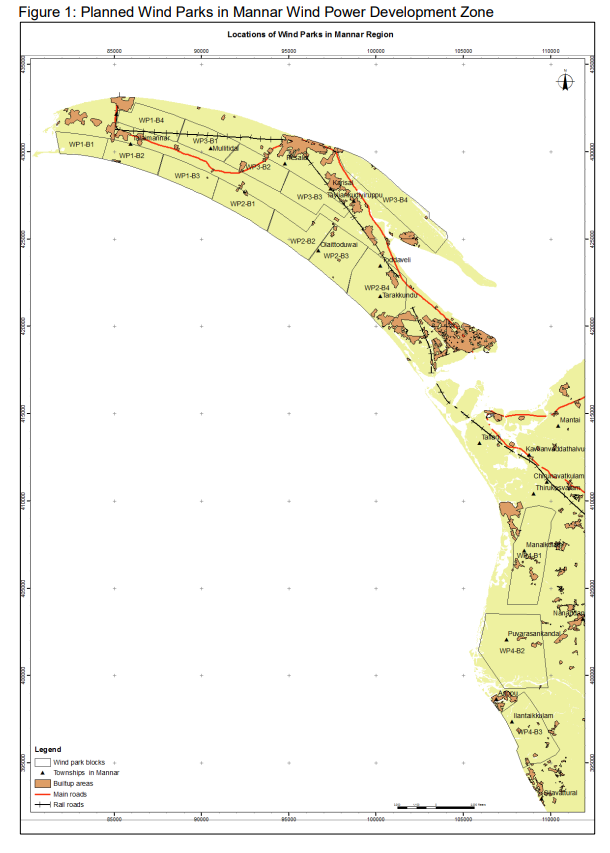
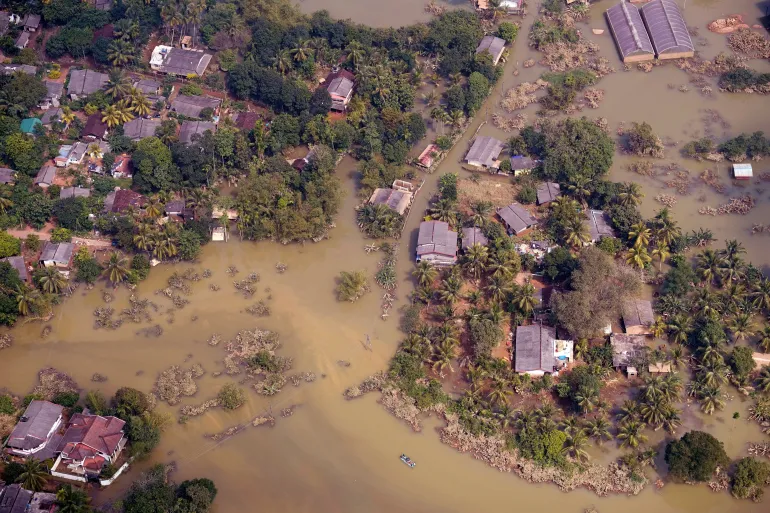
Construction may also change the land itself. Due to heavy machinery and vehicles being brought in for construction, badly engineered roads are damaged even more and palmyrah trees (among others) are cut, causing increased flooding, diversion of waterways, and possible destruction of bird nesting grounds. An attempt was made to alleviate this by digging ditches for drainage and staggering the movement of equipment, but a more methodical solution is likely to be needed. Moreover, the land marked out for the construction of wind power plants often encroaches on built-up residential land. This poses a potential risk to residents if their land is eroded, farmland taken over, or land otherwise damaged through the construction and maintenance of power plants.
Concerns of residents
Amid protests, the government has issued a suspension of the wind farm project, stating that it was willing to engage with residents about the importance of the project and its impact. However, it is unlikely that the project will be permanently halted. Residents of Mannar, some of whom are also protesting proposed ilmenite sand mining in this area, are unlikely to be satisfied, and have launched a campaign to have Mannar declared a protected coastal ecological zone.
Utilizing Mannar for its natural resources seems to show a pattern: residents are often not fully informed beforehand, and, in the case of mining, did not show the relevant permits or clearance, although the equipment for mining had already been brought in. This was also reflected in the Vavunathivu solar farm: not only were residents poorly informed, but weekly repairs often caused a disruption of the entire area’s power supply. This highlights a concerning trend, also shown when in May 2024, Sri Lanka’s Minister of Wildlife and Forest Resources Conservation, Pavithradevi Wanniarachchi, de-gazetted a section of the Vidattaltivu Nature Reserve to set up an aquaculture industrial farm. This gazette was only released in Sinhala and caused a key area of wildlife protection to be lost. This, like the wind farm and ilmenite mining incidents, shows a lack of communication between the government and residents affected by their activities, while also putting key local wildlife at risk.
Kashia Dias is a Biological Sciences undergraduate at Cardiff University. Her interests lie at the intersection of sustainable development, biotechnology, and environmental science.
Factum is an Asia-Pacific focused think tank on International Relations, Tech Cooperation, Strategic Communications, and Climate Outreach accessible via www.factum.lk.
The views expressed here are the author’s own and do not necessarily reflect the organization’s.