By Divya Mascranghe
A National Crisis
Sri Lanka’s landscape is scattered with mass graves; a largely ignored national crisis that transcends communal lines affecting citizens of all ethnic backgrounds. Mass graves were first reported in post-independent Sri Lanka in 1971 following the People’s Liberation Front (or the Janatha Vimukthi Peramuna, JVP) uprising and thereafter in 1987 – 1990. Many of the victims of this insurrection were Sinhala Buddhist Youth1. Following this, numerous mass graves are reported to be scattered around the country, while those found in the North and Eastern Provinces are believed to be a consequence of the 30+ year long war and contained remains of Tamil speaking persons2. Yet, despite its island-wide prevalence, and multi-ethnic victims, these investigations are perpetually halted before they reach completion, leaving behind a systemic trail of unresolved mass gravesites and unidentified bodies.
According to the International Commission of Jurists (ICJ), Sri Lanka has one of the world’s highest unresolved enforced disappearances with an estimated 60,000 to 100,000 cases of missing persons. While most disappearances stem from the 1983 – 2009 conflict, victims of enforced disappearances include Tamil civilians, Sinhalese youth, and “individuals allegedly abducted by security forces, intelligence agencies, or associated paramilitaries,” says the International Commission of Jurists (ICJ)3. While the Office on Missing Persons (OMP), was established to investigate cases of enforced disappearance the ICJ notes critical issues with the OMP and has urged that they “assert its independence” and “operate in line with international standards on truth-seeking and accountability.”4
Thus, on one hand our island has missing and disappeared persons, while on the other hand, there are numerous mass graves scattered around the island with unidentified bodies. Melanie Klinker, (Bournemouth University, Law) in providing an outline of mass graves investigations says, “Mass grave excavations have also the potential to fulfil important humanitarian goals that go well beyond prosecutorial needs. In the aftermath of gross human rights violations, evidence from the field suggests that information as to what happened and how it happened, fulfils a very important need of families and survivors”5
Engineered Ignorance
The Asian Human Rights Commission states that over 30 – 40 mass graves have been found in Sri Lanka over past two decades, which includes both mass graves of state atrocities as well victims of the Tsunami (2004)6. However, according to a news report in August 2025, the Justice Minister at the time stated that Sri Lanka has recorded 17 mass graves7. About approximately 32 graves identified, only 20 have been partially exhumed, and hardly any of the remains have been returned to their families8. While there seems to be a disparity in the numbers presented by the AHRC and the Sri Lankan government, the fact remains there remains large number of such mass graves around the country, which is evidently acknowledged by the State. This disparity also shows a lack of a centralized, transparent database reflecting a systemic ignorance of the issue.
Further, while many Commissions of Inquiry have been established in Sri Lanka, none have been set up to investigate mass graves. Rather, there have been numerous attempts to stifle the truth, and delay the process9. Reports show police delay in carrying out judicial orders, abrupt transferring of magistrates and forensic experts and families’ lawyers being denied access to the site to name a few of the systemic tactics.10
For decades, graves remain unmarked, unprotected11 and disrespected. Forgotten skeletons remain buried, leaving thousands of family members, many of whom are now dying of old age, without closure. This article sheds light on some of these mass graves including one of the most recent ongoing excavations.
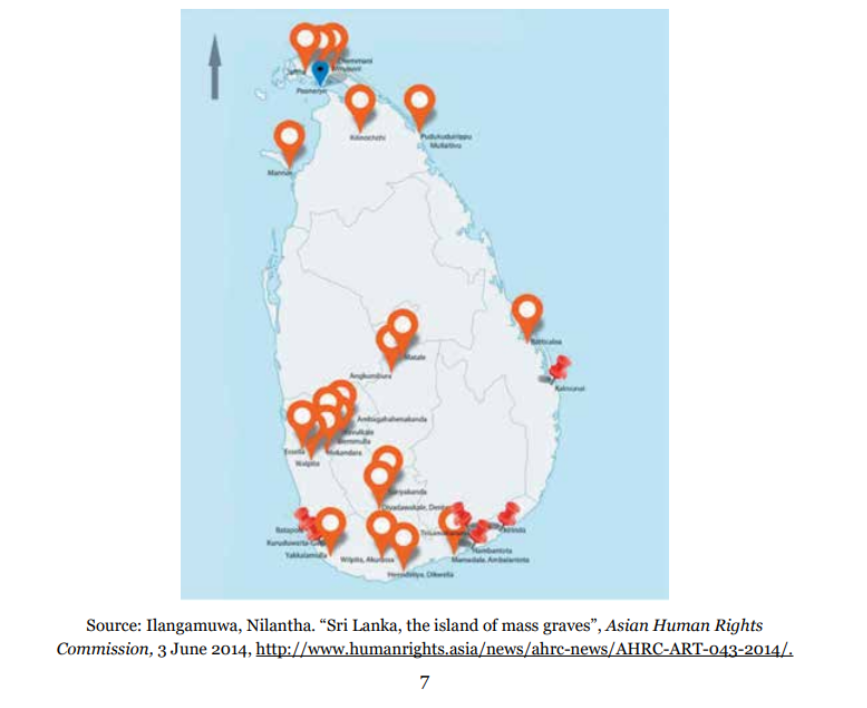
Cataloging the Silence: Major Grave Sites
- Sooriyakanda Mass Grave13
In 1994 the Sri Lankan Government launched a project to build a Ceylon Electricity Board (CEB) tower on a hill in the village of Sooriyakanda near Embilipitiya. A witness contacted veteran journalist Victor Ivan revealing a mass grave on the hill. Court ordered excavations revealed approximately 300 bodies, believed to be Sinhala citizens killed during the 1987 and 1989 uprisings of the JVP. Investigations were subsequently halted in 1995, with most remains still being unidentified. This first official mass grave excavation site now holds only a telecommunication tower, not a memorial marker.
- Colombo Port Mass Grave14
In July 2024, 88 skeletons were discovered in Colombo during the expressway construction. Excavations, supervised by the Colombo Additional Magistrate, were repeatedly halted due to lack of government funding, despite forensic archeologists reporting more skeletons were likely buried there.
- Durayappah Stadium, Jaffna 199915
Approximately 49 bodies suspected to be Tamils killed and buried en masse.
- Matale 201216
Approximately 154 people, believed to be victims of a 1980s JVP insurgency, were unearthed.
- Mannar 2013 – 201817
During pipe laying work of the National Water Supply and Drainage Board skeletal remains were discovered next to a temple and the site was excavated in December 2013 and March 2014. Forensic experts led by the Judicial Medical Officer stated that the bodies had been buried in layers, in a way Atypical of a cemetery. In August 2014 bone fragments were discovered in a well near the mass grave site raising expert concerns that the excavation methods used by the government may have rendered forensic analysis impossible.
In 2018 another site was discovered in Mannar during construction work to build Sathosa, with some suspecting the remains belonged to victims of abduction and torture. However, excavation was halted in 2019 after the discovery of 318 bodies, including 18 children18. While it is likely that there are more bodies to be exhumed, worries arise that a lack of police presence has compromised the site.
- Kaluwanchikudy 201419:
A mass grave that was suspected to contain the remains of about 100 Muslims.
The Living Horror of Chemmani
Chemmani Mass Grave 202520
Krishanthi Krishnamoorthy: The Murder That Unlocked a Grave21,22
In September 1996, 18 year old Krishanthi who was cycling home from school was raped and murdered. Her mother (59), brother (19) and family friend (16) who went in search of her and questioned the military personal at the bunker where Krishanthi was abducted, too were forcibly taken inside the bunker and murdered by military personnel. The Army Authorities later discovered their bodies, and five of the accused confessed their crimes to the Military Police. One of the seven convicted soldiers, Lance Corporal Somaratne Rajapakse, claimed in his 1998 court testimony that hundreds of civilians, detained by the Army during its 1995 – 1996 occupation, were buried in Chemmani. Following Somaratne’s testimony, 15 skeletons were exhumed with forensic evidence showing signs of torture and execution; 2 of them were identified as missing person. However, no further excavations were carried out and no high-ranking officials were held accountable.
However, in February 2025 construction of a Hindu crematorium in Chemmani accidentally uncovered human bones leading to Court supervised excavation. Since then the first 54 days of excavations were conducted in two phases ending on 6th September 2025, under the supervision of the Magistrate. Each day brought on more horrors and more bodies including infants and children buried with their toys, feeding bottles, books and bags; 240 human skeletons were identified out of which 239 skeletons were fully exhumed. Phase 2 ended on a note of familiar systemic hurdles: court was informed of a lack of funds to continue the excavation risking the site being prematurely halted and forgotten.
However, notably, Phase 3 of the Court supervised excavation began on 27th April 2026 since it was halted in September 2025. The said excavation is scheduled to continue for 56 days23.
Discoveries so far include a skeleton with its legs folded in a sitting position24 and skeletons of infants and children with their toys25 and bags26. The belongings were publicly displayed to aid identification. The Human Rights Commission of Sri Lanka, “reasonable likelihood” that the burials at the Chemmani mass grave in the north were “unlawful” and had been caused as a “result of extrajudicial killings”27.
Intimidation and lack of information
Investigating the mass graves would bring closure to families across all ethnicities. Yet, consecutive governments show hesitation in funding and actively pursuing these critical efforts, while public awareness seems limited.
A 2025 analysis by Verite Research shows limited to no mainstream coverage of the ongoing Mass Grave Excavation in Chemmani28. However, photo journalist Kanapathipillai Kumanan has been the eyes and ears for our Island Nation, providing daily updates on social media on the ongoing excavation in Chemmani. He continues to provide regular updates and images from the grave site.
However, on the 17th of August 2025 Kumanan was interrogated for nearly seven hours by the Counter Terrorism Investigation Division (CTID)29 for reasons including journalism “against the government”, “discrediting the military” and “terrorist”30. Kumanan’s interrogation sparked unity31,32 among human rights and press freedom organisations- including the Committee to Protect Journalists (CPJ), Reporters Without Borders (RSF), International Press Institute (IPI), FORUM-ASIA, International Commission of Jurists (ICJ), and others who urged Sri Lanka to end reprisals against Kumanan and withdraw the TID summons. The interrogation of journalist Kumanan underscores the ongoing struggle for truth and transparency in Sri Lanka.
Chemmani is one of several mass graves in Sri Lanka. The ICES report says that despite the unearthing of hundreds of bodies across Sri Lanka over the last few decades, “of the few investigations conducted, none were successful in fully identifying victims, establishing stable narratives of events preceding each grave, or prosecuting responsible actors”.33
As the Chemmani excavations continue, they are a stark reminder of all the buried and forgotten mass graves scattered across the country. Chemmani not only unearths the remains of the past but also exposes a present where efforts to uncover buried truths are met with silence and resistance, ensuring the cycle of impunity remains unbroken.
Divya Mascranghe is an Attorney-at-Law, writer, and researcher. She holds an LLB from the University of London and is an MA candidate in Gender and Women’s Studies at the University of Colombo, where she previously completed her postgraduate diploma of the same. She is also a Public Policy and Leadership Fellow of St. Stephen’s College, Delhi. Using intersectional frameworks, her work focuses on human rights, women’s rights, ethnic minority issues, and systemic advocacy.
Factum is an Asia-Pacific-focused think tank on International Relations, Tech Cooperation, and Strategic Communications accessible via www.factum.lk
The views expressed here are the author’s own and do not necessarily reflect the organizations.
Factum is an Asia-Pacific-focused think tank on International Relations, Tech Cooperation, and Strategic Communications accessible via www.factum.lk
The views expressed here are the author’s own and do not necessarily reflect the organizations.