By Dinouk Colombage
As the conflict with Iran enters its second week, the threat of an expansion of the theatre of war from the Middle East into surrounding regions has become a very grave possibility. This last week saw U.S. military operations extend beyond the Gulf and into the Indian Ocean, violating the 1971 U.N. Declaration of the Indian Ocean as a “Zone of Peace”.
Following the sinking of an Iranian naval vessel by an American submarine, and the Freedom of Navigation in the Indian Ocean under threat, two other Iranian naval vessels have sought refuge in India and Sri Lanka, highlighting the distinct possibility of future military strikes. While the United of States of America’s conduct, in the ongoing war in Iran, points to an undeniable fact that an end goal has not been decided upon, the use of military force beyond the Gulf is clearly an option that will be utilized.
When the bombardment of Iran commenced last Saturday (28) afternoon, the justifications emanating from both Israel and the United States was that this was an assault to pre-empt Iran obtaining a nuclear weapon. America soon expanded this rationale into claiming that Iran was a clear and present danger to the citizens of their country and needed to be dealt with. Despite growing concerns back in Washington, President Donald Trump has doubled down on his commitment to the ongoing strikes, stating that only “unconditional surrender” would see America halts its bombardment of Iran.
While domestically the U.S. is facing a fresh set of hurdles as per public support, internationally the war in Iran has not garnered the expected backing from the country’s allies. The United Kingdom, traditionally a wartime ally of the U.S. has not turned out in full support, irking President Trump.
Speaking to media last week, the U.S. President took a swipe at England’s Prime Minister, Keir Starmer, describing him as “no Winston Churchill,” referring to the UK’s wartime Prime Minister in World War 2. While the Prime Minister initially appeared to brush off the criticisms, he has since positioned his country into a supportive role for the conflict. Prior to February 28, UK media reported that the U.S. were refused permission to use their military base on the island of Diego Garcia to launch any strikes against Iran. Since then, the stance appears to have shifted. Fresh reports from England state that their RAF airbases in Gloucestershire and Diego Garcia are being prepared to receive the U.S. B-2 high altitude bombers. Clearly responding to the taunts and barbs thrown his way by President Trump, the UK Prime Minister has brought his country to brink of officially entering the war.
England is not alone among the U.S. allies who are finding themselves drawn into the conflict, despite reservations among their respective citizenry over another potentially decades long conflict in the Middle East. On Friday, following the surprise sinking of the Iranian naval vessel, IRIS DENA, within Sri Lanka’s Exclusive Economic Zone by a U.S. submarine, Australian Prime Minister Anthony Albanese confirmed that Australian sailors had been aboard the vessel. This was part of ongoing training exercises under the much-criticised AUKUS agreement. The presence of Australian military personnel aboard a vessel engaging in military operations against Iran raised eyebrows not only back in Australia but around the region. While Prime Minister Albanese attempted to distance themselves from the attack, stating that the Australians had not engaged in any active duty, the presence of the sailors suggests that Australian military officials would have been aware ahead of time of the strike against the naval vessel which took place with regional neighbour’s Exclusive Economic Zone.
On either side of Iran, in Europe and Asia, American allies have unwittingly been drawn further into a conflict that has already disrupted the Gulf region, impacting the global economy. While the war in Iran is just one of several ongoing conflicts around the world, analysts are now exploring the possibilities of whether it could lead to the outbreak of World War 3. At this stage, while there is little to suggest that it would result in a military polarization of the global order, actions by the U.S. have seen the theatre of war with Iran expand beyond the Middle East.
On Wednesday (4) morning news emerged that an Iranian naval vessel was under distress just 40 nautical miles off the coast of Sri Lanka’s Southern Coast. While operations by the Sri Lankan navy were underway to rescue the sailors, rumours were swirling that in fact the vessel had been struck in a military operation. Nearly 12 hours after the news first emerged, the self-titled U.S. Secretary of War, Pete Hegseth, announced that they were responsible for the strike. This marked the first time since World War 2 that a foreign submarine had sunk a vessel in the Indian Ocean (the last time being 1971 when the Pakistan navy submarine PNS Hangor sank the Indian navy frigate INS Khukari). This incident not only pronounced an escalation in the conflict, which until then had been restrained to aerial bombardment from both sides, but it also opened a new theatre of war outside of the Middle East.
A desire by America to expand the conflict into the Indian Ocean is supported by the rationale that active military presence in the region would dissuade any potential military support for Iran emanating from east of the Strait of Hormuz. Ahead of the February 28 strikes on Iran, reports indicated that the U.S’ 5th Fleet, traditionally tasked with overseeing the Middle East, including the Red Sea and the Arabian Gulf, had been positioned as a staging area for U.S. military operations in the Gulf.
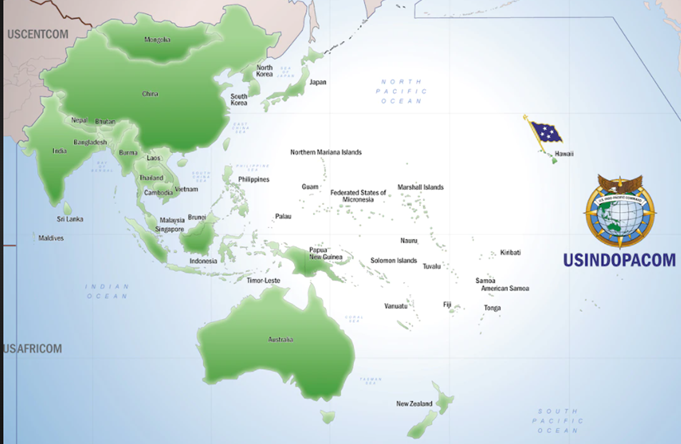
However, interestingly the 5th Fleet was bolstered ahead of the commencement of operations by the USS Gerald R Ford, which belongs to the 7th Fleet, who is tasked with the responsibility of overseeing the Indian and Pacific Oceans. Coupled with the recent attack on an Iranian naval vessel in the Indian Ocean, the inclusion of the 7th Fleet suggests that America is prepared to expand the theatre of war into the Indian and Pacific regions.
As the U.S. and Israel ramp up their military operations against Iran, the Iranian regime has demonstrated that they too are willing to expand their targets of retaliation beyond Israel and U.S. military assets in the region. Shortly after the initial bombing of Iran, the Islamic Revolutionary Guard Corp (Iranian Revolutionary Guards) launched a series of retaliatory strikes across the Middle East. Leading up to the conflict, Iran had issued warnings to its neighboring states that in the event of an attack by America all U.S. assets in the region were considered legitimate targets. The UAE, Bahrain, Kuwait, Iraq, Qatar and Saudi Arabia have all been on the receiving end of drone and missile strikes by the Iranians.
While the greater majority have U.S. military assets in those countries, the UAE has found its civilian infrastructure including hotels and the airport also struck during the bombardments. Similarly, Saudi Arabia has also seen its energy infrastructure targeted by Iranian strikes. At the time of writing these nations have been restrained in their responses, allowing Israel and the U.S. to shoulder the greater burden of warfare with Iran. However, as airspaces remain partially closed and air-travel greatly disrupted, it does pose the question as to how long these countries will continue to bear the economic burden of the continued disruption and heightened tensions in the region. Whether this will result in a military response or the Gulf States suing for peace is still unclear.
As the world’s attention remains on Iran and the region, concerns continue to grow that further escalations will lead to a rapid spread of the conflict beyond the Middle East. With a deafening silence by both Sri Lanka and India over the sinking of the Iranian vessel within Sri Lanka’s Exclusive Economic Zone, the Indian Ocean and the global shipping lines in the region are now open to military strikes. While further military action in the region would not lead to an expansion of actors in the conflict, it will certainly heighten Big Power rivalry and threatens to spread the instability beyond the Middle East.
Dinouk Colombage is the Chief Research Officer for the Geopolitical Cartographer and the former Director of International Affairs to President Ranil Wickremesinghe.
Factum is an Asia-Pacific-focused think tank on International Relations, Tech Cooperation, and Strategic Communications accessible via www.factum.lk.
The views expressed here are the author’s own and do not necessarily reflect the organization’s.