By Vidura Munasinghe and Natasha Van Hoff
Energy transitions are rarely simple technical upgrades. They represent fundamental reorganizations of political and economic power. Today, as the global economy rapidly pivots toward renewable energy, we are witnessing a troubling reality: the centralized, predatory structures that defined the fossil fuel era are being seamlessly reproduced within the new green economy. Far from dismantling historical inequities, the current trajectory of the energy transition risks reinforcing long-standing imperial patterns under a new, environmentally friendly mantle. In developing nations like Sri Lanka, this global dynamic intersects with local structural inequalities, threatening to turn the promise of clean power into a driver of land grabs, economic dependency, and corporate enrichment.
The History of Energy and Exploitation
To understand this cycle, we must look at history. Major energy shifts have rarely been driven by resource scarcity or pure cost efficiency; they have always been about accumulating capital and controlling labor.
The transition from water power to coal during the Industrial Revolution did not happen because coal was cheaper, but because it offered mobility. Coal liberated production from fixed riverbanks, allowing capital to concentrate labor in urban factories, spawning global capitalism, and ultimately fuelling resource-extracting imperialism (Hobsbawm, 1975). The geopolitical footprint of the British Empire was, in essence, a network of strategic coal refuelling stations designed to protect trade routes and extract resources worldwide.
However, coal required massive labor forces to mine and transport it. When organized labor movements grew powerful enough to threaten this system in the early twentieth century, global powers orchestrated a shift to oil (Malam 2016). Moved easily through pipelines, oil bypassed labor disruptions and reduced workers’ leverage over the energy grid. Imperial powers carved up Middle Eastern borders based strictly on oil deposits, later handing administrative control over to multinational cartels (Michell, 2011) like Shell, Chevron, ExxonMobil, and BP. For developing nations like Sri Lanka, this transition established a structural trap: absolute technological and economic dependency on foreign corporations.
The New Green Hegemony
Today’s renewable energy transition is following the same playbook. Critical minerals like lithium, cobalt, and nickel are replacing the oil barrel. Supply chains remain firmly dictated by American, European, and Chinese corporations, while traditional oil giants buy their way into becoming wind and solar monopolies.
Three eras illustrate this pattern. The Coal Era centered on stationary and mobile coal, dominated by Imperial Britain through firms like BP Coal, The British South Africa Company, Chevron Mining, and BHP, with exploitation carried out through forced labor concentration, territorial annexations, and strategic coaling stations. The Oil Era shifted the dominant resource to liquid hydrocarbons, controlled by Western multinationals such as Shell, Chevron, ExxonMobil, BP, Glencore, and TotalEnergies, with exploitation now taking the form of sovereign border manipulation, labor bypass via pipelines, and petrodollar debt traps. Today’s Green Era centers on critical minerals and mega-renewables, dominated by global conglomerates including Chevron, BP, Equinor, ExxonMobil, Glencore, Energy X, TFM, and Ganfeng Lithium, with exploitation manifesting as green land grabs, opaque concessions, and predatory climate finance loans.
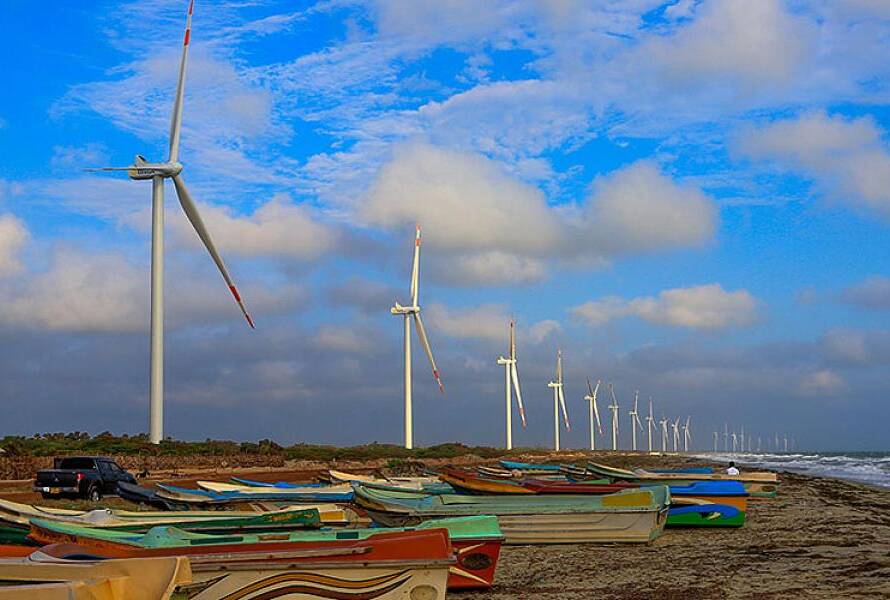
This consolidation of market power is fuelling a new wave of “green colonialism.” Building mega-scale solar or wind plants requires seizing hundreds of acres at a time, resulting in massive land grabs, the loss of common lands, and widespread local displacement (Müller, 2024).
This spatial displacement is reinforced by a modern iteration of financial exploitation. In the 1970s, the petrodollar system forced developing countries to borrow in dollars just to buy foreign fuel, locking them into endless cycles of high-interest debt. Today, under the guise of the “green economy,” developing nations are being pushed into a new debt trap through predatory “green loans” that strip local populations of decision-making power over their own resources. While renewable energy is our only viable path forward, we must dismantle these inherited structural dependencies, or the promise of the green transition will be lost (Michell 2011; Müller, 2024).
Ground Reality: Structural Violations and Opaque Siting in Sri Lanka
In Sri Lanka, this global framework manifests as corporate-led energy projects that treat energy purely as a tradeable commodity and a mode of wealth accumulation. We need to bring an intersectional lens to this transition, highlighting ground-level resistance in localities such as Mannar, Hambantota, and Muttur. Rather than treating energy as a purely technical issue, we must ask whether the current transition is equitable, or if it is merely working within a discriminatory system that worsens existing structural inequalities.
A central issue in Sri Lanka’s energy trajectory is a severe deficit of transparency and community consent regarding project siting.
- Hambantota (Walsapugala): In an area with a long history of agrarian land struggles, local communities only discovered their lands, lands they had fought for years to protect, were being seized when solar panels were physically being installed.
- Mannar (Kondachchi and Mullikulam): In these heavily militarized northern zones, land denied to displaced residents for years following the end of the civil war is now being handed over to private energy developers rather than being returned to its rightful owners. (Fieldwork data, 2025)
Across these regions, Free, Prior, and Informed Consent (FPIC) is bypassed entirely, with developers securing signatures under pretenses or skipping public consultation. Siting decisions are routinely made with the patronizing assumption that local communities lack technical knowledge, allowing state and private developers to finalize deals behind closed doors before ever consulting residents (Thudugala et al. 2026).
Furthermore, these developments threaten the wider rural economy. Ecosystems are deeply interconnected; large-scale projects damage natural environments, alter hydrology, and destroy local livelihoods kilometers away from the immediate construction plots. People have every right to question these decisions, as they directly and indirectly shatter their lives and ways of living.
Democratizing Sri Lanka’s Energy Future
Unlike countries further along in their development pathways, such as Indonesia (da Silva, et al. 2025; Herman, 2026), Sri Lanka is still in the early stages of its energy transition. People can still shape its trajectory to ensure equity in the process. However, current observations show a transition that remains opaque and inaccessible. It is incredibly difficult to access basic government plans explaining why massive solar parks and wind farms are consistently prioritized over decentralized rooftop solar.
To prevent corporate capture, Sri Lanka must pivot to a people-centered transition where energy is not an end for corporate profit, but a means to improving people’s quality of life. Based on respect for rights and socio-environmental justice, energy must be treated as an essential good and a fundamental right. Achieving this requires four interconnected processes:
- Democratization of Energy: Transferring decision-making power and asset ownership away from centralized state monopolies and private corporations directly to local communities, local governments, and provincial councils.
- De-privatization: Transitioning away from profit-driven corporate frameworks toward public utility models that guarantee subsidized power, support local livelihoods, and lower electricity bills for end-users.
- Decentralization and De-concentration: Moving beyond merely unbundling the Ceylon Electricity Board (CEB) to execute a physical and administrative shift from massive, centralized power grids to distributed energy resources like community rooftop solar.
- De-fossilization and De-colonization: Pairing the physical elimination of fossil fuels with a thorough de-colonization of the thinking around energy, rejecting the idea that energy security requires top-down corporate dominance.
Holding the State Accountable
The fundamental choice facing Sri Lanka’s energy future is not merely technical, but political. Policymakers and civil society must directly confront several rhetorical questions and hold the state accountable:
- For whom is this energy transition being conducted?
- Does it truly benefit the people it should, through subsidized, affordable energy?
- Who leads this transition, who owns the infrastructure, and who ultimately earns from it?
If these questions remain unaddressed, the green transition will simply re-encode the extractive, imperialist structures of the fossil fuel era under a clean banner. Only by breaking these old structures and establishing democratized, community-controlled systems can Sri Lanka achieve true energy sovereignty and socio-environmental justice.
Vidura Munasinghe is a Senior Researcher and Natasha Van Hoff is a Researcher at the Law and Society Trust. This article draws on speeches and presentations delivered by the authors, along with Nur Herliati Herman, at the colloquium “Powering a Just Future: Creating a ‘Good Energy’ Framework for Sri Lanka’s Energy Transition,” organized by the Law & Society Trust on 8 July 2026.
Factum is an Asia Pacific-focused think tank/consultancy on Diplomacy, Tech-Plomacy, Digital and Energy Futures accessible via www.factum.lk.
The views expressed here are the author’s own and do not necessarily reflect the organization’s.